

Forty-five hours. That is how much time Dubai drivers lost to traffic congestion in 2025, according to the TomTom Traffic Index. Not driving — sitting still, engine running, lower back gradually rounding into the car seat. For residents who commute daily from areas like Mirdif, Al Barsha, or anywhere across the Sharjah border, that figure does not feel abstract. It feels like every weekday evening on the Emirates Road.
The back pain that follows a long day in the car is easy to attribute to stress, age, or “just sitting too much.” What is harder to see is the specific mechanical process happening each time you settle into that seat, and why doing it thousands of times compounds in ways that ordinary rest does not fully undo.
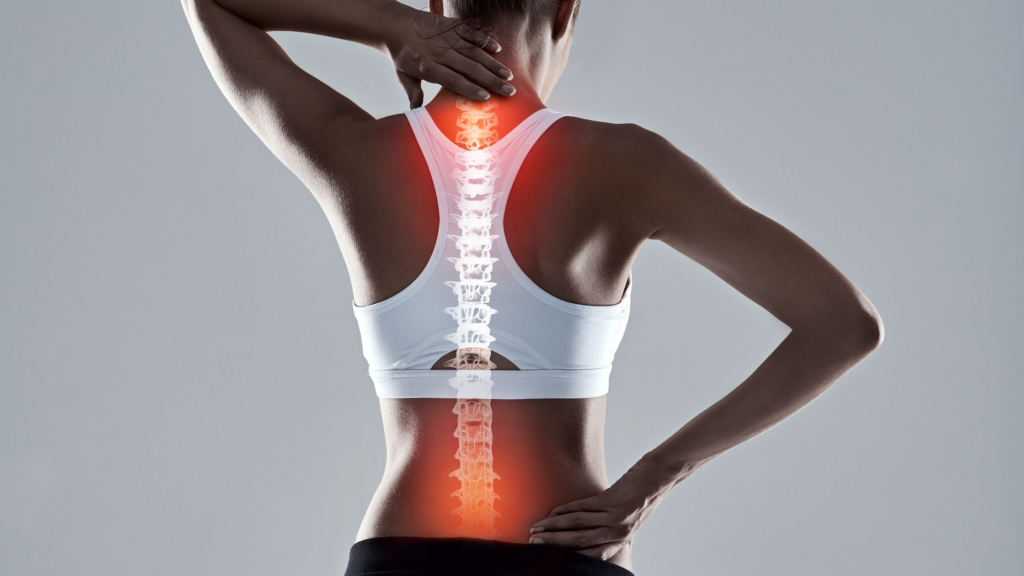
What Happens the Moment You Sit Down
A car seat is not designed around your spine. It is designed around manufacturing constraints, cost, average body dimensions, and the assumption that most journeys are short. The result, for the vast majority of vehicles, is a seat that encourages the pelvis to rotate backward the moment you sit down.
When the pelvis tilts back, the natural inward curve of the lower back flattens. The lumbar spine moves from its supported S-shape into a C-shape. Research published across multiple biomechanics studies, including work by De Carvalho and Callaghan, has consistently shown that this kyphotic driving posture increases intradiscal pressure and places additional stress on the posterior elements of the spine. It is not a dangerous position for five minutes. It becomes a problem for 45 minutes twice a day, every working day.
Add to this the vibration that travels through the seat from the road surface. Vibration at low frequencies has a dose-response relationship with lower back pain in drivers — meaning the more exposure, the greater the risk. On Dubai’s roads, where highway driving alternates with the stop-start of congestion through Business Bay or along Sheikh Zayed Road, the spine absorbs both prolonged static loading and intermittent mechanical shock within the same commute.
The Accumulation Nobody Notices
The reason driving-related back problems develop slowly is that the individual journey rarely feels damaging. A single 40-minute commute produces stiffness that fades after a short walk. So most people conclude nothing has happened. Over months and years, however, the discs are repeatedly compressed in a position that restricts their ability to rehydrate properly, the small stabilizing muscles of the lumbar spine gradually weaken from disuse, and the hip flexors — held shortened in the car seat as on any chair — start to pull the pelvis into a forward tilt that persists even after the driver has left the vehicle.
By the time someone presents with persistent lower back pain that does not resolve with rest, that pattern is often well established. The driving did not create a single injury. It created a cumulative condition.
This matters particularly for anyone who combines a long commute with a desk job. Sitting in a car for 90 minutes, working at a desk for eight hours, and returning via another 90-minute commute means the lumbar spine has been in a compromised position for the majority of the waking day. That is the reality for a substantial portion of Dubai’s working population.
The Adjustments That Actually Make a Difference
Car seat ergonomics are worth taking seriously, not as comfort preferences but as genuine injury prevention.
- Seat height and distance: The knees should be roughly level with or slightly below the hips. Sitting too low forces excessive hip flexion, which increases posterior pelvic tilt. Sitting too close bunches the legs and does the same. Most people set these by reach rather than by posture.
- Lumbar support: The built-in lumbar support in most cars can be adjusted. A small roll or lumbar cushion placed just above the belt line restores some of the natural curve that the seat removes. It should feel supportive, not rigid.
- Headrest position: The headrest should sit directly behind the skull, not behind the neck. A low headrest encourages the head to drift forward, loading the cervical spine with every moment of stillness in traffic.
- Steering wheel reach: Gripping a wheel that is too far away rounds the upper back and pulls the shoulders forward. The elbows should be soft, not locked, with the wheel close enough to allow the shoulder blades to stay against the seat back.
None of these requires a new car. They require five minutes of adjustment that most people never make because nothing hurts enough yet to prompt them.
Getting Out of the Car Is Part of the Treatment
The simplest intervention available is also the most underused. Getting out of the vehicle and walking briefly, even for two or three minutes, at a fuel stop, a school drop-off, or a parking bay before entering the office allows the lumbar spine to decompress and the hip flexors to lengthen. The discs begin to re-absorb fluid. The postural muscles reactivate.

People who drive long distances in Dubai regularly, particularly those who travel frequently between emirates, should treat movement breaks as a functional necessity rather than a convenience. Fifteen minutes of sitting at a rest stop with the seat reclined achieves very little compared to five minutes of upright movement.
Targeted back and spine treatment is worth considering for anyone whose lower back symptoms have crossed from occasional to persistent. The difference between a disc that is irritated and one that has begun to degenerate is partly a matter of how long the irritation goes unaddressed.
When the Commute Becomes a Medical History
Driving-related spinal problems are manageable when caught at the right stage. A stiff lower back after a long journey that loosens up during the day is a warning sign, not an inevitability. Persistent morning stiffness, pain that radiates into the buttock or leg, or a back that feels worse after rest than during activity are patterns that warrant professional attention.
Our orthopedic specialists at Westminster Multispecialty Clinic, based at Dubai Healthcare City, assess spinal conditions with both the clinical picture and the patient’s daily mechanics in mind. A commuting pattern that contributes to symptoms is part of the picture, not separate from it. Physiotherapy and rehabilitation guided by an orthopedic assessment can address both the existing problem and the habits that produced it. If your back has been telling you something for longer than it should, schedule a consultation before the next stage arrives.