
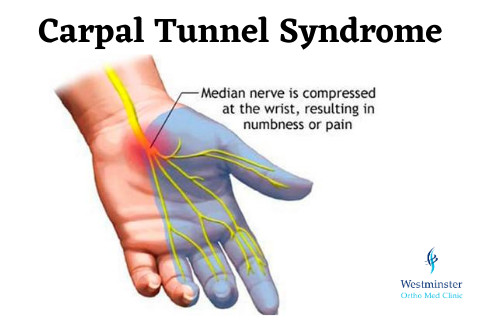
Carpal tunnel syndrome is a condition caused by compression of the median nerve in the wrist. The nerve passes through a space in wrist called the carpal tunnel and is accompanied in the tunnel by a number of tendons. The nerve provides sensation in the thumb, index, middle and half of the ring fingers of the hand, as well as innervating some of the muscles of the thumb.
Carpal tunnel syndrome occurs when pressure builds up within the tunnel and compresses the nerve which then ceases to function normally, giving rise to numbness, tingling, and pain felt in the hand and fingers and occasionally in the forearm.
What causes carpal tunnel syndrome
You’re more at risk if you:
- Are overweight
- Are pregnant
- Do work or hobbies that mean you repeatedly bend your wrist or grip hard, such as using vibrating tools
- Have another illness, such as arthritis or diabetes
- Have a parent, brother or sister with CTS
- Have previously injured your wrist
The symptoms of carpal tunnel syndrome include:
- An ache or pain in your fingers, hand or arm
- Numb hands
- Tingling or pins and needles
- A weak thumb or difficulty gripping
These symptoms often start slowly and come and go. They’re usually worse at night.
In order to diagnose a detailed history including medical conditions, work, hobbies and sport, and whether there have been any prior injuries is important. An X-ray may be taken to check for other causes of the complaints such as arthritis or a fracture. In some cases, laboratory tests may be carried out if there is a suspected medical condition that is associated with carpal tunnel syndrome Electrical studies of function of the median nerve (nerve conduction studies) may be undertaken to confirm the diagnosis and assess the severity of the condition.
Treatment for carpal tunnel syndrome
Non-surgical treatment
Symptoms can often be relieved without surgery. Identifying and treating medical conditions, changing the patterns of hand use, or keeping the wrist splinted in a straight position may help reduce pressure on the nerve. Wearing wrist splints at night may relieve the symptoms that interfere with sleep. Anti-inflammatory medication taken by mouth or steroid injected into the carpal tunnel may help relieve the carpal tunnel symptoms.
Surgical treatment for carpal tunnel syndrome
When symptoms are severe or do not improve by other means, surgery may be required. Pressure on the nerve is reduced by dividing the ligament which forms the roof (top) of the tunnel on the palmar side of the hand and in so doing enlarge the tunnel. Following surgery, soreness around the incision may last for several weeks or months. The numbness and tingling may disappear quickly or slowly. It may take several months for strength in the hand and wrist to return to normal. Carpal tunnel symptoms may not completely resolve after surgery, especially in severe cases.
Should you require additional information or would like to make an appointment with Dr. Ishrat Khan,Consultant Orthopedic Surgeon, please call us or e-mail us at info@westminsterclinic.ae
Disclaimer: All contents on this site are for general information and in no circumstances information be substituted for professional advice from the relevant healthcare professional, Writer does not take responsibility of any damage done by the misuse or use of the information.
Comments
binance Norāde
gate推荐代码
www.binance.info sign up
开设Binance账户
Trịnh Gia Huy
Hà Gia Linh
sportzfy tv live
Hà Thành Đạt