
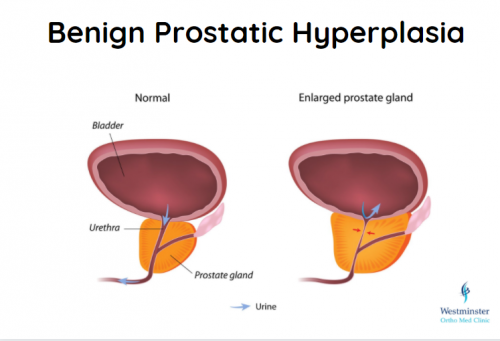
Benign Prostatic Hyperplasia (BPH) also called prostate gland enlargement. It is a common condition as men get older. An enlarged prostate gland can cause uncomfortable urinary symptoms, such as blocking the flow of urine out of the bladder. It can also cause bladder, urinary tract or kidney problems.
Benign Prostatic Hyperplasia is common in men aged over 50. It’s not a cancer and it’s not usually a serious threat to health.
As the prostate enlarges, it presses against the urethra. The bladder wall becomes thicker. One day, the bladder may weaken and may not be able to empty fully, leaving some urine in the bladder. Narrowing of the urethra and urinary retention – not able to empty the bladder fully – cause many of the problems of Benign Prostatic Hyperplasia.
Symptoms of Benign Prostatic Hyperplasia
When the prostate is enlarged, it can bother or block the bladder. Needing to pass urine often is a common symptom of BPH. This might include the need to pass urine as often as every one to two hours, mainly at night.
Other symptoms include:
- Feeling as though the bladder is full, even right after passing urine
- Feeling that passing urine “cannot wait” or urgency
- A weak flow of urine or dribbling
- Needing to stop and start passing urine many times
- Trouble starting to pass urine
- Trouble starting to urinate
- Needing to push or strain to pass urine
- Waking up many times nightly with the need to pass urine
Less common signs and symptoms include:
- Urinary tract infection
- Inability to urinate
- Blood in the urine
Risk factors
Risk factors for prostate gland enlargement include:
- Aging. Prostate gland enlargement rarely causes signs and symptoms in men younger than age 40. About one-third of men experience moderate to severe symptoms by age 60, and about half do so by age 80.
- Family history. Having a blood relative, such as a father or a brother, with prostate problems means you’re more likely to have problems.
- Diabetes and heart disease. Studies show that diabetes, as well as heart disease and use of beta blockers, might increase the risk of BPH.
- Lifestyle. Obesity increases the risk of BPH, while exercise can lower your risk.
Diagnosing Benign Prostatic Hyperplasia
See your doctor if you have symptoms that might be related to BPH. See your doctor right away if you have blood in your urine, pain or burning when you pass urine or if you cannot pass urine.
There are many tests for BPH. The following tests are used to diagnose and track BPH.
1. Symptom Score Index
The American Urological Association (AUA) has built a BPH Symptom Score Index. It is a series of questions about how often urinary symptoms happen. The score rates BPH from mild to severe. Take the test and talk with your doctor about your results.
2. Physical Exam
A digital rectal exam (DRE) is often the next step. During a DRE, you would lie on your side or bend over. The doctor inserts a gloved, lubricated finger into your rectum to feel the back wall of the prostate gland
3. Urine Tests
The tests are done to measure how well you release urine. This shows the doctor if the urethra is blocked or obstructed. There are several types:
- Urinalysis tests your urine sample to check for important things such as blood, signs of infection, glucose (sugar), protein and other factors that can tell your urologist the cause of your symptoms. Urine tests are also used to screen for bladder cancer. If you have blood in your urine, pain or burning when you pass urine, or you cannot pass urine, it is important to see your doctor right away.
- Post-void residual volume (PVR) measures urine left in the bladder after passing urine. This is done to diagnose the problem. IT may also be done before surgery.
- Uroflowmetry measures how fast urine flows. This is done to diagnose the problem. It may also be done before surgery.
- Urodynamic pressure flow study tests pressure in the bladder during urination.
4. Scans
These tests are done to see the size and shape of the prostate. Some BPH scans include:
- Ultrasounds look inside the body to see the size and shape of the prostate.
- Cystoscopy is an exam used to look at the urethra or bladder with a scope.
- Magnetic resonance imaging (MRI) and computed tomography (CT) for more detailed scans. These are done if surgery is necessary to reopen the flow of urine. These scans provide a very clear image of the prostate and surrounding area. It shows exactly how and where the prostate is enlarged.
5. Blood Test
- Prostate-specific antigen (PSA) blood test is used to screen for prostate cancer. The PSA blood test checks the level of PSA, a protein made only by the prostate gland. This blood test can be done in a lab, hospital or a provider’s office. Avoid sexual activity several days prior to the test, as this may artificially increase the PSA reading.
Treating benign Benign Prostatic Hyperplasia
Treatment for an enlarged prostate will depend on how severe your symptoms are.If the symptoms are mild, you do not usually need immediate treatment, but you’ll have regular prostate check-ups.
lifestyle changes will be advised such as:
- Drinking less alcohol, caffeine and fizzy drinks
- limiting your intake of artificial sweeteners
- Exercising regularly
- Drinking less in the evening
Medicine to reduce the size of the prostate and relax your bladder may be recommended to treat moderate to severe symptoms of an enlarged prostate.Surgery is usually only recommended for moderate to severe symptoms that have not responded to medicine.
Should you require additional information or would like to make an appointment with our Consultant Dr. Noor Buchholz, please call us or e-mail us at info@westminsterclinic.ae
Reference
- www.Nhs.uk
- Urologyhealth.org
- health.harvard.edu
Disclaimer: All contents on this site are for general information and in no circumstances information be substituted for professional advice from the relevant healthcare professional, Writer does not take responsibility of any damage done by the misuse or use of the information.
Comments
Binance referral
código da binance
binance konto
binance "oppna konto
binance "oppna konto
Đoàn Thùy Dương
Phan Phương Linh
Đoàn Thu Trang
Lý Trung Kiên