
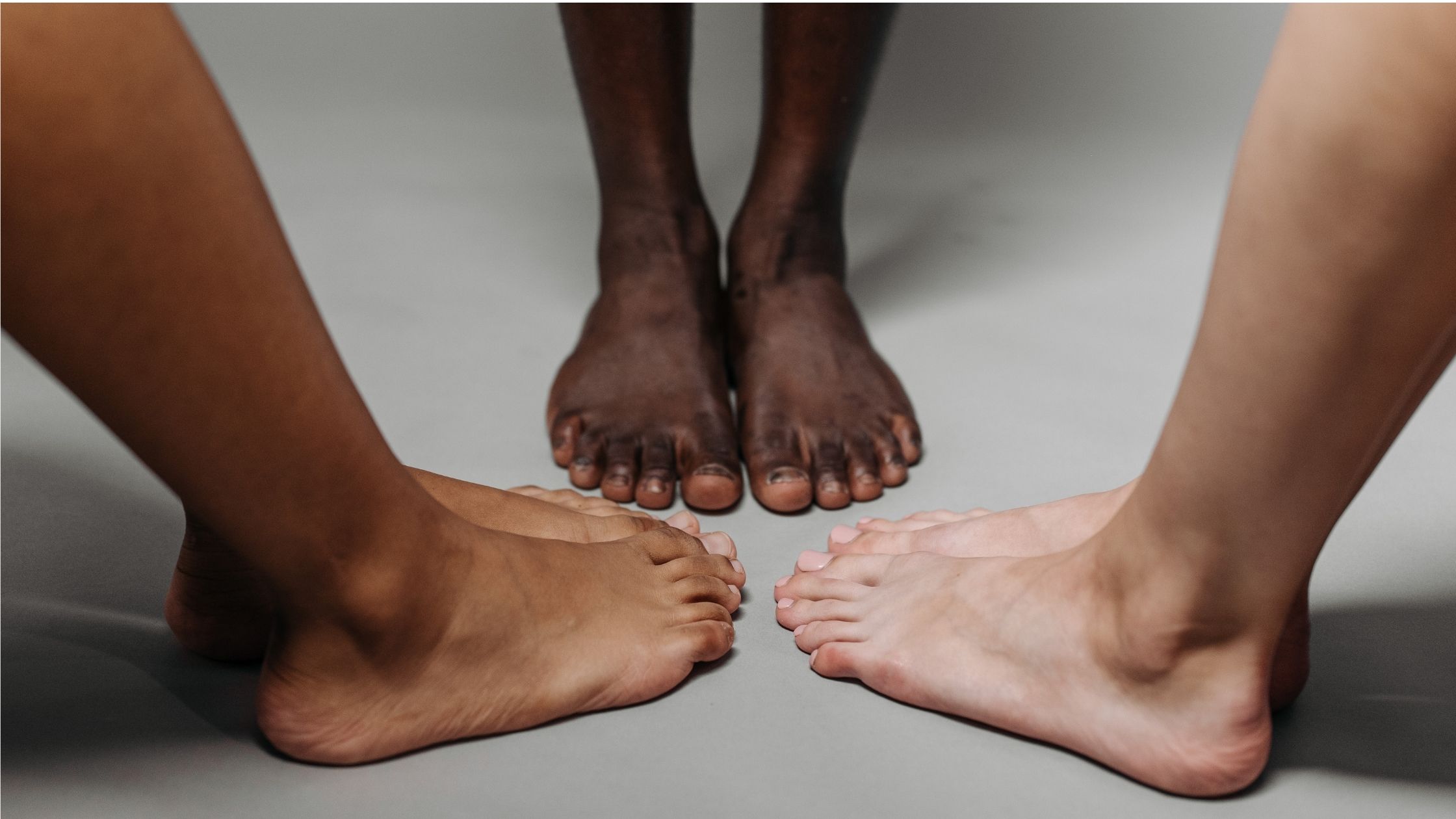
Flat feet are not automatically a problem. A large number of people walk around Dubai with little to no visible arch and never think about their feet at all. What determines whether flat feet become a source of pain is not the shape of the arch itself, but how well the rest of the body has adapted to it.
Pes planus, the clinical term for flat feet, means the arch along the inside of the foot has flattened or never fully developed. A systematic review published in the Journal of Foot and Ankle Surgery, drawing on twelve studies and more than 16,000 participants, found an overall flatfoot prevalence of around 15.6% globally. Region-specific figures for the UAE are not currently available, though the underlying mechanics apply regardless of where someone lives.

Why the same condition affects people so differently
The arch of the foot works as a shock absorber and a lever. It flattens slightly under load and springs back to help push the body forward with each step. When the arch is naturally low or collapsed, that spring action is reduced, and the surrounding muscles, tendons, and joints have to compensate to keep walking efficient. This compensation is often invisible for years, since the body is remarkably good at redistributing load quietly before pain ever enters the picture.
Some people compensate well. Strong calf and foot muscles, good hip control, and supportive footwear can mean a flat foot causes no discomfort for decades. Others compensate poorly, and the flattened arch changes how force travels up through the ankle, knee, and hip with every step, eventually producing pain in areas that seem unrelated to the foot itself.
Signs that flat feet have become more than a cosmetic feature
- Arch or heel pain after standing or walking for extended periods, particularly on hard flooring
- Aching along the inside of the ankle, which often points to strain on the posterior tibial tendon
- Knee or hip discomfort with no clear injury, caused by altered alignment travelling up the leg
- Uneven or rapid wear on the inside edge of shoes
- A visible inward roll of the ankle when standing or walking, known as overpronation
None of these signs mean surgery is needed. They do mean the foot’s natural shock-absorbing system is under more strain than it can currently manage, and that strain tends to compound the longer it goes unaddressed.
How Dubai’s daily environment plays a role
Marble and tile flooring, common across Dubai’s malls, offices, and residential buildings, offers almost none of the shock absorption that grass or trail surfaces provide, which places more direct load on an already compromised arch. Long days on foot, whether at Dubai Mall, on a construction or hospitality shift, or simply during a full day of errands in Downtown Dubai, add up in ways that a flat foot handles far less efficiently than a supported one. Flip-flops and unsupportive sandals, worn often in the local climate, remove what little external support the foot might otherwise get, leaving weak arch muscles with even less assistance.
None of this causes flat feet. It does explain why the same underlying foot shape produces real pain in one environment and none in another.
Who tends to notice it first
Flat feet that caused no issues in someone’s twenties often start producing pain later, as the muscles and tendons supporting the arch naturally lose some strength and elasticity with age. Weight gain adds direct load to an arch that was already working close to its limit, which is one reason flat foot pain frequently appears alongside other lifestyle changes rather than in isolation. Pregnancy is another common trigger, since hormonal changes loosen ligaments throughout the body, including the ones supporting the arch, sometimes permanently altering foot shape. People who have recently increased how much walking or standing their day involves, a new job, a house move, a fitness routine built around long walks, often notice arch or heel pain appearing for the first time simply because the foot is now under more sustained load than it has been asked to manage before.
Addressing the root cause rather than the symptom
Orthotic insoles are often the first thing people try, and they can help by supporting the arch externally. What they do not do is address why the foot’s own muscles are not doing that job already. At Westminster Multispeciality Clinic, Dubai Healthcare City, a physiotherapy assessment looks at the entire kinetic chain, checking foot and ankle strength, calf flexibility, hip control, and walking pattern, since a flat foot rarely causes pain through the arch alone. Two people with an identical arch height can need completely different treatment plans depending on where the rest of their compensation pattern has broken down.

Treatment typically combines targeted strengthening of the small stabilising muscles in the foot and ankle, calf and Achilles flexibility work where tightness is limiting normal foot mechanics, and gait retraining to correct compensations that have built up over years. Manual therapy is often used alongside this to address stiffness that has developed in the joints of the midfoot and ankle from years of altered movement. Where the foot and ankle need more focused attention, our ankle sprain and foot injury rehabilitation programme addresses the joint and soft tissue directly. Where pain has begun affecting the knee, hip, or lower back through altered alignment, our general musculoskeletal physiotherapy service treats the wider pattern rather than the foot in isolation.
Most people see meaningful improvement within six to eight weeks of consistent treatment, since the muscles supporting the arch respond well to progressive strengthening once given the right stimulus. Footwear advice is usually part of this process too, since a supportive shoe for daily wear makes a measurable difference to how much work the foot’s own muscles need to do. Orthotics remain useful for some people long term, and unnecessary for others once the underlying weakness has been addressed directly.
Flat feet are a foot shape, not a diagnosis on their own. Pain is the signal that the shape and the body’s current ability to manage it are no longer matching up, and that gap, once identified properly through our physiotherapy services, is usually far more fixable than people expect. Getting an accurate picture of what is actually happening, through our Contact Us page and a full assessment, is the difference between managing symptoms indefinitely and resolving the pattern causing them.