

The knee holds up fine walking on flat ground. Then a staircase appears, at a metro station, in a Downtown Dubai apartment block, at the office, and the pain shows up right on cue. A dull ache going up. A sharper twinge coming down. It becomes something people quietly plan around, taking the lift even for one flight, avoiding the stairs at the mall, without ever really asking why a joint that works fine most of the day struggles so specifically with this one movement.
Stairs demand more from the knee than walking does. Climbing a single step can load the knee joint with several times body weight, concentrated through a smaller range of motion than a normal stride. Descending is often worse, since the quadriceps have to control the body’s weight against gravity rather than simply propel it forward. Any weakness, tightness, or early wear in the joint tends to surface first on stairs, long before it becomes obvious during ordinary walking.

Why the knee reacts to stairs specifically
A few conditions account for most stair-related knee pain, and they show up in different ways.
Patellofemoral pain syndrome involves the kneecap tracking incorrectly against the thighbone as the knee bends. It is common in people who sit for long stretches, a familiar pattern for Dubai’s office workforce, since prolonged sitting weakens the muscles that keep the kneecap aligned. The pain typically sits at the front of the knee and worsens specifically on stairs, especially going down.
Early-stage knee osteoarthritis is another common cause, particularly from the mid-forties onward. Cartilage in the joint gradually thins, and the smooth gliding motion the knee depends on becomes less forgiving under the concentrated load that stairs create. A retrospective study using the Dubai Real-World Claims Database, examining more than 11,600 patient records, found that among adults aged 45 to 54 in Dubai, average knee osteoarthritis prevalence sat at 1.4%, with minimal difference between UAE nationals and expatriates. It is one of the main reasons arthritis and joint stiffness rehabilitation exists as its own area of care rather than a footnote to general knee treatment.
Meniscus wear or minor tears also present this way. The meniscus cushions the joint and can degrade slowly with age or fray suddenly from a twisting movement, and stairs, which combine bending and weight-bearing at once, tend to expose this kind of damage quickly.
What tends to make it worse
- Weak quadriceps and glutes, which leave the knee absorbing load the surrounding muscles should be sharing
- Tight hip flexors and calves, which change how weight travels through the knee during a step
- Carrying extra load, whether body weight or a heavy bag, up and down stairs regularly
- Ignoring the early, mild version of the pain until it becomes a daily presence
None of these causes it outright. They tend to combine, so a person with a slightly weak quadriceps and a long daily walk from a Dubai Metro platform up to street level ends up with pain that a stronger, more mobile knee would have absorbed without issue.
Who notices this pain first
Certain groups tend to run into stair-related knee pain earlier than others. Runners and padel players, both common across Dubai’s active community, place repeated impact through the knee at speed, which shows up as stiffness or soreness on stairs the following day. People who have recently increased their step count sharply, whether through a new fitness routine or a change in daily commute, often feel it as their knees adjust to a workload they were not previously conditioned for. Office workers who sit for most of the day and then encounter stairs only occasionally, at the mall, at a friend’s building, on a weekend outing to Downtown Dubai, are also common candidates, since the muscles around the knee have had little chance to stay active.
Footwear plays a role too. Shoes with little cushioning or arch support change how force travels through the ankle and knee, and this becomes more noticeable on stairs than on flat pavement.
What physiotherapy actually does here
Stair-related knee pain is rarely fixed by rest alone, since rest does not address the strength or alignment problem underneath it. A physiotherapy assessment typically starts by working out which of the above is driving the pain, since patellofemoral pain, early osteoarthritis, and meniscus irritation are treated differently even though they can feel similar day to day. At Westminster Multispeciality Clinic, Dubai Healthcare City, our physiotherapists in Dubai build this into knee pain physiotherapy designed around what the joint specifically needs, rather than a standard programme applied regardless of cause.
Treatment usually combines a few elements. Targeted strengthening, particularly of the quadriceps and hip muscles, gives the knee the support it is currently missing. Manual therapy addresses stiffness in the joint and surrounding soft tissue that is changing how the knee moves. Gait and movement retraining looks at how someone actually climbs and descends stairs, since small adjustments to technique often reduce load on the joint meaningfully.
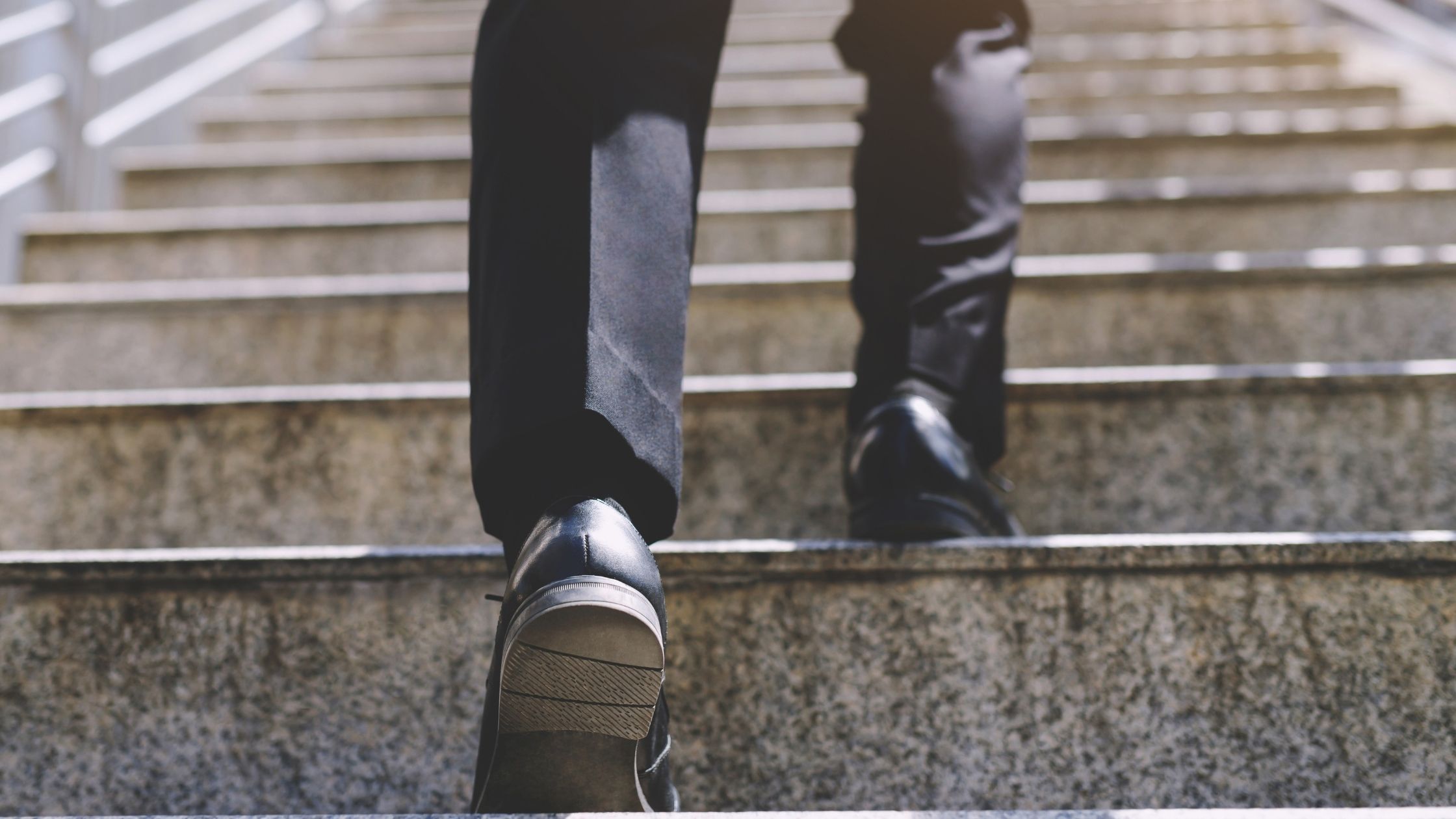
A typical course begins with an assessment of how the knee moves under load, watching the joint through a squat, a step-up, and often a short flight of stairs, rather than relying only on where the pain is reported. Exercises are then chosen for the specific muscles found to be underperforming, rather than a generic set applied to every knee that walks in. Most people notice a genuine difference within a few weeks, and stairs stop being something to avoid, which matters in a city built with towers, walkways, and multi-level parking that make stair avoidance genuinely difficult to sustain long term.
When it is worth getting assessed
Pain that is limited to going down stairs, that has lasted more than two or three weeks, or that is joined by swelling, a catching sensation, or a feeling that the knee might give way, is worth having looked at properly through our physiotherapy services. Waiting rarely makes the underlying mechanics better on its own, and a knee that has been compensating for months is a longer rehabilitation than one addressed early. Reaching out through our Contact Us page is usually the fastest way to get a clear answer on what is actually going on.
A knee that struggles on stairs today is telling you something specific about how it is currently working. Left alone, that pattern tends to spread, showing up on inclines, during longer walks, eventually on flat ground too.