
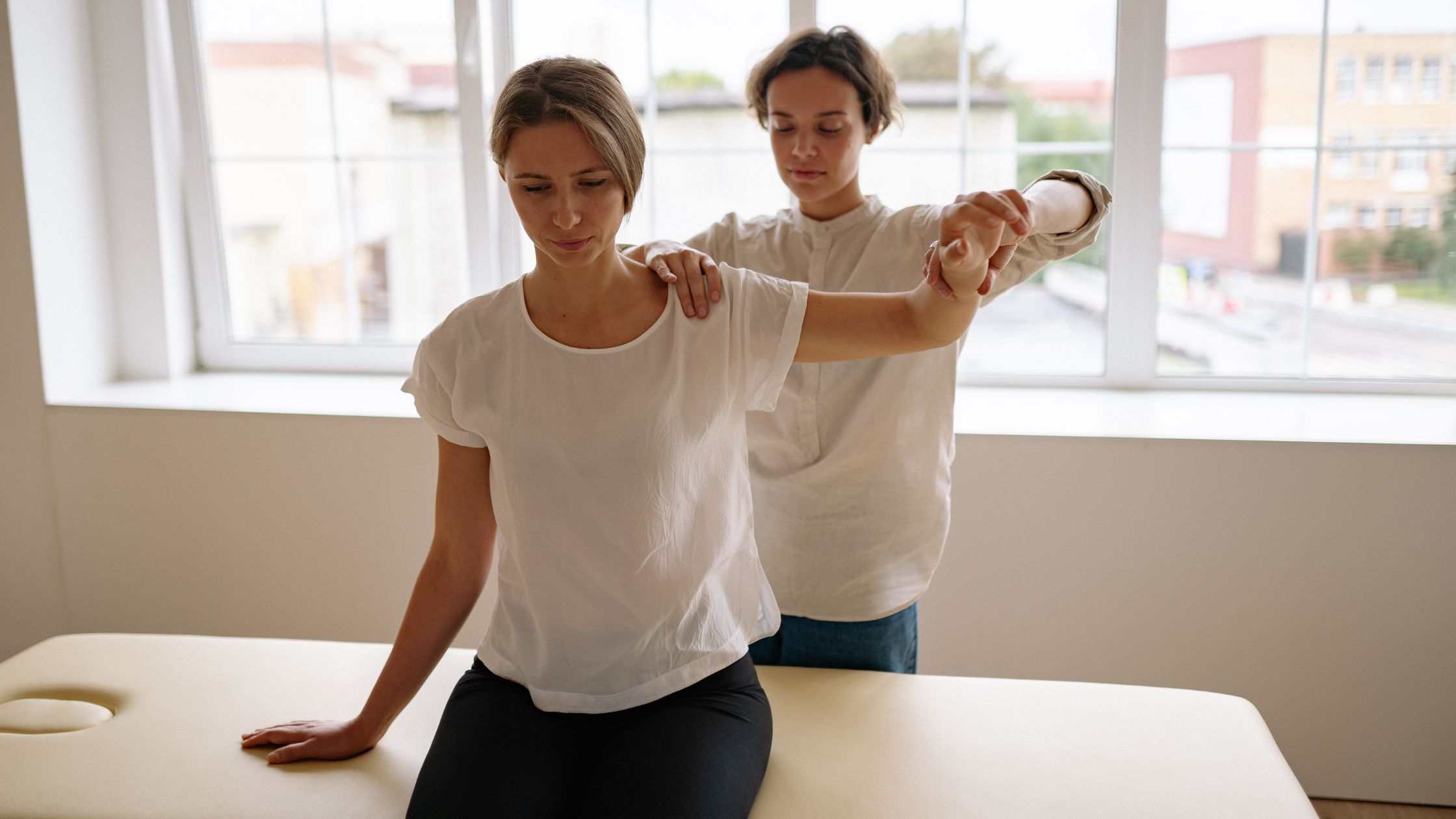
Someone lies down for what they expected to be a routine physiotherapy session and the physiotherapist starts working with their hands instead of pointing them toward a machine or a set of exercises. No ultrasound wand, no electrical pads, just pressure, movement, and a joint being guided through a range it has not moved through in months. Patients often ask afterward what exactly just happened to their body, and why it worked as fast as it did.
That hands-on approach is manual therapy, one of the oldest tools in physiotherapy and still one of the most effective for specific conditions.
What is actually happening during manual therapy
Manual therapy covers a group of hands-on techniques a physiotherapist uses to assess and treat pain, stiffness, and restricted movement. It is not a single technique but a category, and which one gets used depends entirely on what the joint or tissue needs.

- Joint mobilisation involves slow, controlled movements that gently push a stiff joint toward the end of its range, restoring motion the joint has gradually lost.
- Soft tissue mobilisation targets muscles and fascia that have tightened or developed knots, often from posture, overuse, or compensating for an injury elsewhere.
- Myofascial release works on the connective tissue wrapping the muscles, which can restrict movement even when the muscle itself is not the source of pain.
- Manipulation, a quicker, more targeted movement usually reserved for specific joint restrictions, is used less often and only when appropriate for the condition.
Each of these does something a machine cannot. A physiotherapist’s hands can feel exactly where tissue is restricted, adjust pressure in real time based on how the body responds, and change technique mid-session if something is not working. That real-time feedback loop is the part most patients do not see. A physiotherapist adjusting pressure based on how a muscle responds under their hands is making dozens of small decisions a session, something a fixed machine setting cannot replicate.
Why physiotherapists reach for it
Manual therapy is rarely used on its own. It is usually paired with an exercise programme, and the combination is where the real benefit shows up. A systematic review and meta-analysis on chronic low back pain found that adding manual therapy to an exercise programme produced disability improvements of roughly seven to sixteen points on a standard disability scale, within or slightly beyond the threshold considered clinically meaningful for patients.
That pattern shows up across most of what manual therapy treats. It does not replace the strengthening and movement retraining that fixes the underlying cause. It reduces pain and restores movement quickly enough that the exercise programme can actually start working, since a joint that will not move and a muscle that will not release make it nearly impossible to do the exercises properly in the first place.
This is the part that gets missed most often outside a clinic. People sometimes assume manual therapy alone should fix chronic pain permanently, and when the pain returns weeks later they conclude the treatment did not work. In most cases what happened is that the manual therapy did its job, opening up movement and reducing pain, but the strength and movement patterns behind the original problem were never rebuilt afterward.
What it actually helps with
Manual therapy tends to work best for conditions involving joint stiffness, muscle tightness, or restricted movement rather than pure muscle weakness.
Frozen shoulder rehabilitation is one of the clearest examples. A shoulder that has stiffened to the point where reaching overhead is impossible often needs hands-on mobilisation before stretching or strengthening exercises can even be attempted, because the joint capsule itself has tightened in a way exercise cannot immediately reach.
Neck and back pain linked to stiff segments of the spine, rather than a disc or nerve issue, also respond well, as do headaches that originate from tension in the neck and upper back. Back pain physiotherapy in Dubai frequently combines manual therapy with core strengthening for exactly this reason, addressing the immediate stiffness while building the support that keeps it from returning.
Chronic pain conditions where muscles have tightened protectively around an old injury, sometimes years after the original injury healed, are another common case. The tightness itself becomes a separate problem that manual therapy can directly address.
Desk-related stiffness across the upper back and shoulders, common among office workers across Business Bay and Downtown Dubai who spend eight or nine hours a day in the same seated position, tends to respond quickly to manual therapy as well, particularly when combined with simple changes to desk setup and posture.
What it is not
Manual therapy is often confused with a spa massage, and the difference matters. A massage generally aims to relax the person and relieve general muscle tension. Manual therapy is a targeted clinical technique, chosen based on an assessment of a specific joint or tissue restriction, and adjusted throughout treatment based on how the body responds. It can feel similar in the moment, but the intent and the precision behind it are not the same thing.

It also is not a permanent fix on its own. A physiotherapist who relies only on manual therapy without addressing the strength or movement pattern that caused the stiffness in the first place is treating the symptom, not the cause. That is why most treatment plans in Dubai Healthcare City clinics pair it with a structured home exercise programme rather than offering it as a standalone session.
Getting the most out of it
The people who benefit most from manual therapy are usually the ones who treat it as the opening move in a longer plan rather than the entire plan. A stiff joint that regains motion in one session still needs the surrounding muscles retrained to keep it that way, and skipping that step is how the same stiffness quietly returns a few months later.
Our physiotherapy specialists in Dubai use manual therapy as part of a broader treatment approach built around each patient’s specific restriction, not a one-size-fits-all technique applied the same way to every condition. Anyone dealing with stiffness, restricted movement, or pain that has not responded to rest can explore physiotherapy services to see how manual therapy might fit into their recovery, or reach out to the clinic to book an assessment.