
A shoulder that pops back into place is not a shoulder that has healed. That single misunderstanding sends more patients back to the clinic a second and third time than almost any other orthopedic assumption in Dubai.
The emergency room visit ends the same way for most first-time dislocations: a doctor reduces the joint, the arm goes into a sling, the pain fades within days, and the patient walks out believing the injury is behind them. What actually happened is that the ball of the humerus slipped out of a socket that was never very deep to begin with, and in doing so it likely stretched or tore the soft tissue structures that were supposed to hold it there. The joint looks fine on the outside. Underneath, it is often less stable than it was an hour before the injury.
Why the Shoulder Fails Where Other Joints Don’t
Every other major joint in the body trades some mobility for stability. The hip sits deep in a bony socket. The knee is wrapped in thick ligaments. The shoulder gives up almost all of that structural security in exchange for range of motion, which is why a healthy shoulder can reach overhead, behind the back, and across the body in ways no other joint can manage. A golf swing on one of Dubai’s coastal courses or an overhead smash on a padel court both depend on that range.

The tradeoff is a joint held together mostly by soft tissue: the labrum, the joint capsule, and a group of ligaments that do the work a deeper socket would otherwise do. Damage any of them in a dislocation, and the joint keeps its full range of motion while losing the one thing that made that range safe.
The Numbers Nobody Mentions in the ER
A systematic review and meta-analysis published in the British Journal of Sports Medicine, pooling data from ten studies and more than 1,300 patients, found that recurrent instability following a first-time traumatic anterior shoulder dislocation occurred in 39 percent of cases. Patients under 40 carried a dramatically higher risk of recurrence than older patients, and the risk climbed further for men and for anyone with naturally loose joints. That statistic rarely comes up during the initial reduction, because the emergency priority is putting the joint back and managing acute pain, not projecting risk five years down the line.
For a young athlete playing five-a-side football at a Dubai Sports City pitch or training for triathlon season along Jumeirah Beach, that 39 percent figure is the difference between one bad afternoon and a shoulder that fails again during a routine reach for a ball, a bag, or a steering wheel.
What “Instability” Actually Feels Like
Instability does not always announce itself as a full dislocation. Patients describe it in smaller, stranger ways that are easy to dismiss.
- A dead arm sensation: A brief loss of strength or feeling during overhead movement, often during sport, that passes within seconds.
- A shoulder that feels loose reaching backward: Common when putting on a seatbelt, reaching into a back seat, or swimming freestyle.
- Apprehension during specific positions: A subconscious flinch or hesitation when the arm moves into the exact position where the original injury happened.
- Clicking or catching that wasn’t there before: Often a sign of labral tissue that didn’t reattach cleanly.
None of these feel like an emergency. All of them are the joint telling a patient something the ER visit did not.
Where Physiotherapy Helps and Where It Runs Out
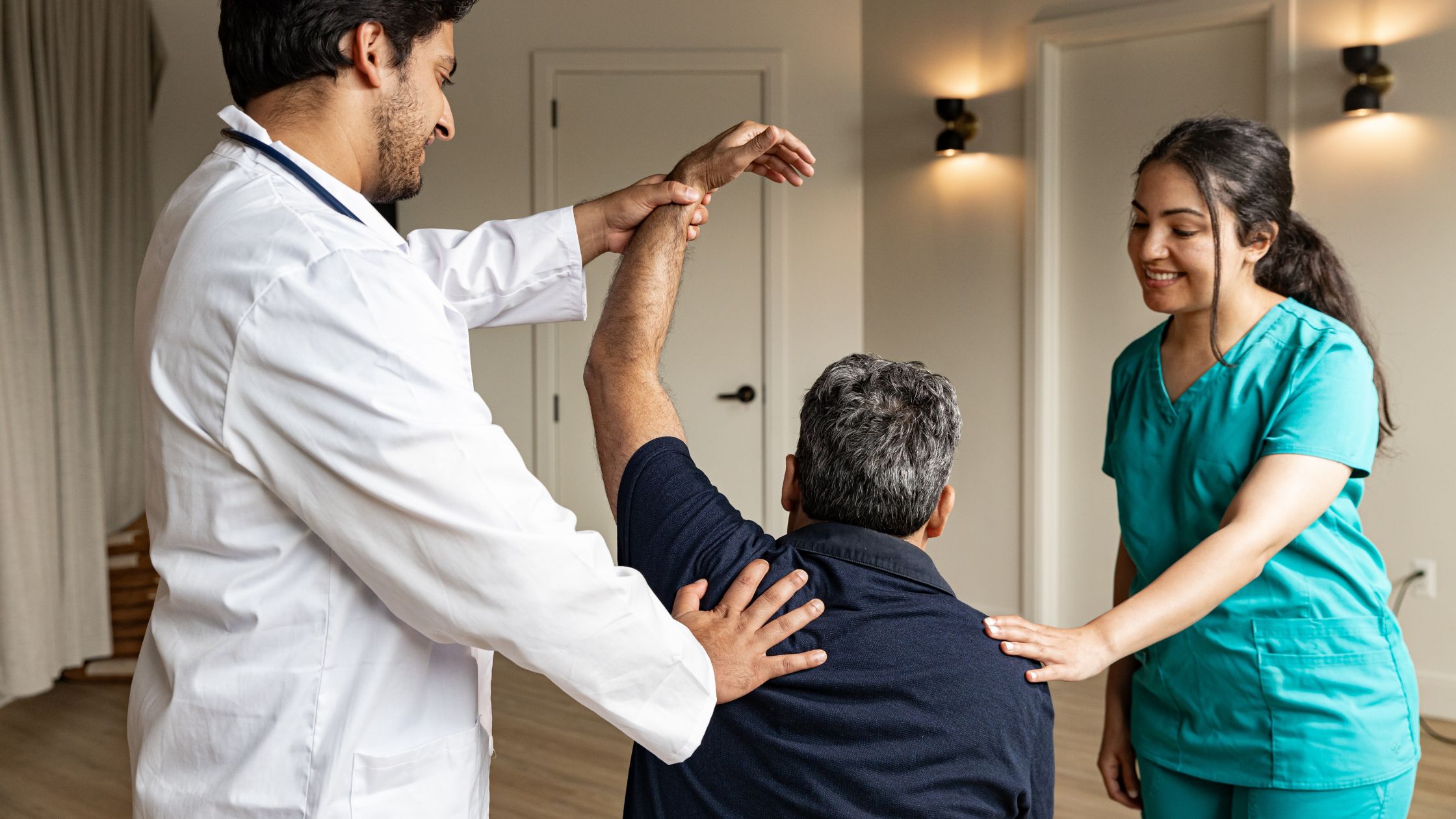
Nonsurgical rehabilitation is the right starting point for most first-time dislocations, particularly in patients over 40 whose recurrence risk is naturally lower. A structured physiotherapy program focused on strengthening the rotator cuff and scapular stabilizers can meaningfully reduce the odds of a second episode, and most patients in Dubai are steered toward exactly this route before anything more invasive is discussed.
But strengthening the muscles around a joint cannot rebuild a torn labrum. This is where the conversation tends to divide. A 22-year-old rugby player with a torn labrum and a history of recurrence is a different clinical picture from a 55-year-old office worker who dislocated once falling off a bicycle on Al Qudra trails and has no ongoing looseness. Physiotherapy alone may be enough for one and insufficient for the other, and the mistake most patients make is assuming the same treatment plan applies to both.
When Surgery Enters the Conversation
Arthroscopic stabilization repairs the torn or stretched tissue that failed during the original dislocation, most often the labrum, through small incisions rather than an open procedure. It is generally the recommended path once bone loss around the socket exceeds a certain threshold, or once a patient has already experienced a second or third dislocation, since each episode tends to cause more soft tissue and occasionally bone damage than the one before it.

Patients recovering from rotator cuff and shoulder repair procedures typically follow a longer, more deliberate rehabilitation timeline than a straightforward sprain, and that patience is part of what makes the repair hold. Athletes returning to overhead sports, in particular, benefit from the same structured approach used after arthroscopic sports injury surgery elsewhere in the body: build stability before testing range, and build range before testing power.
The Question Worth Asking After the First Episode
The question that matters is not whether the shoulder went back into place. It is whether the structures that were supposed to keep it there are still doing their job. That is not something a patient can assess by moving the arm around in front of a mirror, and it is not something an emergency room visit is designed to answer.
Our orthopedic specialists in Dubai assess shoulder instability with exactly that distinction in mind, at Dubai Healthcare City, where imaging and clinical testing can identify which patients are genuinely low risk and which ones are one bad reach away from a repeat visit. A first dislocation is an event. What happens next is a decision, and it is worth making with more information than a sling and a discharge form provide. Book an assessment before the second episode makes that decision for you.